Data Overload?
Issue #13
How did you sleep last night?
Wait, are you checking your Whoop band right now?
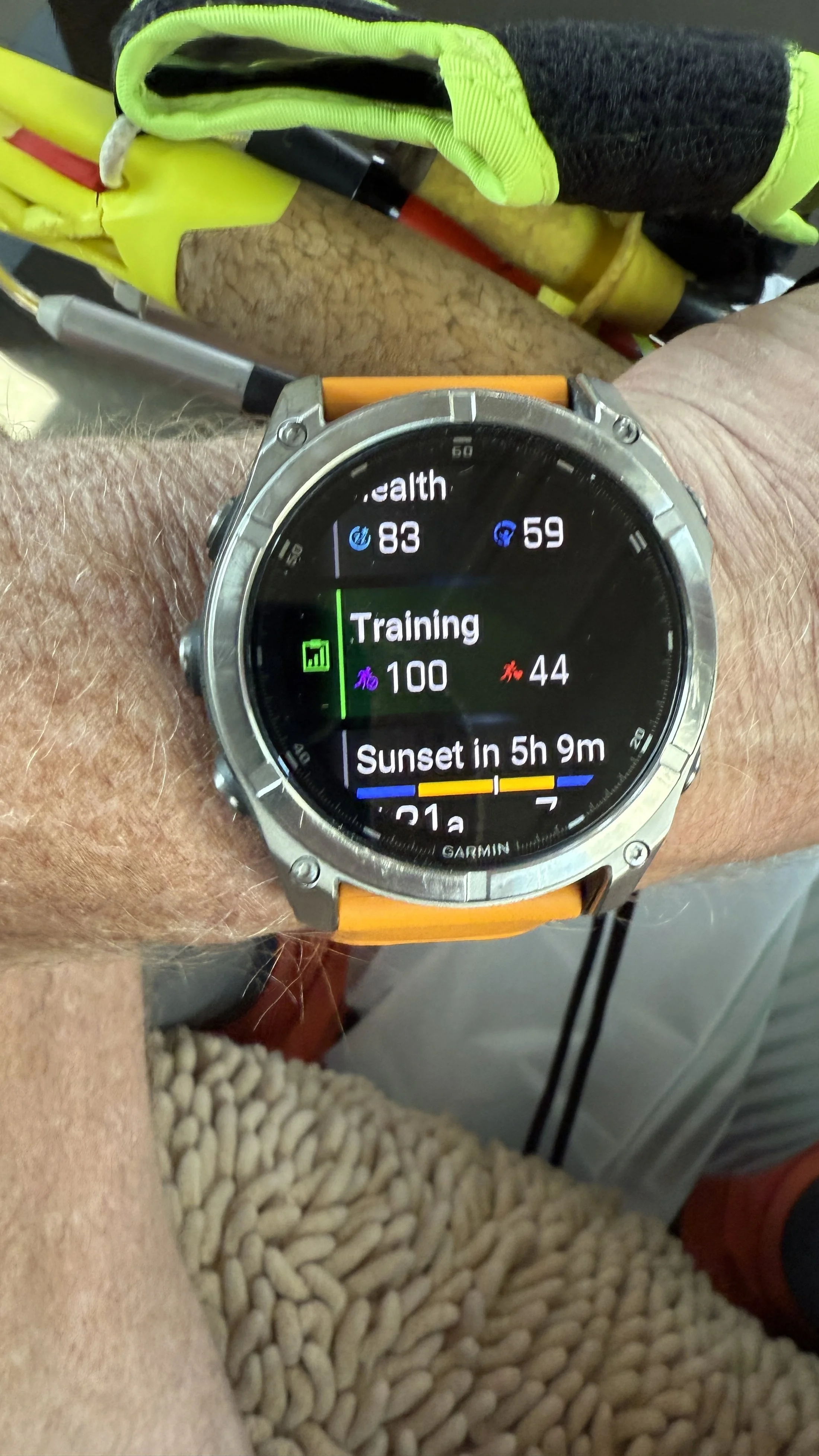
You’re not alone. We are a world preoccupied with fitness tracking devices and data-driven living. I still have a Garmin watch because I love data! How else can I track where I've run, the climbs and descents, the mileage and progress over the years?
But, when it comes to reading my psychological and physiological wellbeing — my sleep quality, mood, aches, calories required — I am my own tracking device.
That wasn’t always the case. When I entered the uber-competitive world of Ironman in 1999, Polar heart rate chest straps were the newest tech. I was all in, using it to help me peg my efforts. Then, along came the power meters for cycling, which I used to measure pedaling strain in real-time.
Garmin introduced their version of a chest strap, which was a must-have. Mio was one of the first watch trackers with a heart rate monitor — yes, please. And then Garmin’s watch, which became synonymous with durability and accuracy. Next, I got a Suunto Smart Heart Rate Belt because it was much more comfortable than the plastic ones. Later, a brief dalliance with Apple Fitness.
Apart from my trusty Garmin watch, all those devices landed in the bin.
Disconnecting from digital data wasn’t easy. I was so conditioned to checking my stats, my progress and achievements, that moving without a device felt weird, even pointless: why push myself unless I knew the exact numbers and recorded them?
It took a while, but I stopped paying attention to all the data.
Racing in Ironman competitions had become a singularly focused exercise in monitoring the data, coordinating the intensity, gritting my teeth and not much more. It was all about the quantitative result, no experience needed. Time for a change.
What I wanted was more qualitative, the experience and what I needed for the long game was to reconnect with my brain. I had lost the ability to read my body’s signals because I had become over reliant on external gizmos that captured my everyday behaviors, habits and activities.
I had dulled my god-given tracking system, replacing self-awareness with numerical data.
Going device-free snapped me into being more present – I had to be. I tuned in to reading signals, rather than numbers, and figuring out the process ahead. I realized that every athletic situation was nuanced and had far more variables than a single number could ever reveal. Suddenly, running felt more like a meditation in movement, where the outcome was less important than each step I took in the process.
Another truism: The way I run today — chasing happiness rather than digital milestones — would almost always be recorded as a negative on a fitness app. If I stop to speak with a stranger or take a photo of a wildflower, I’ll probably get scolded by a bot later: “Today’s run was slower than yesterday’s.”
So, I’m happy to leave the quantification of our lives to the companies who want our money and need our data. There’s simply no device that could ever quantify the unquantifiable joy and magic I encounter on the road.
Supposedly, there was a sign outside Albert Einstein’s door that read, “Not everything that counts can be measured, and not everything that can be measured counts.”
I like that.
Hope to see you on the road (not on Strava!)
Cheers,
David.
An idea:
You can love your devices, but don’t overanalyze the data. Stats like running a fifteen-minute mile, or walking at a 22-minute pace, can be deflating. They don't sound that impressive. Instead, develop a connection with your body and listen to the message it's sending: It’s saying it wants to go even further tomorrow, and the next day, and the one after that. Now, you feel like a rock star.