Issue #16

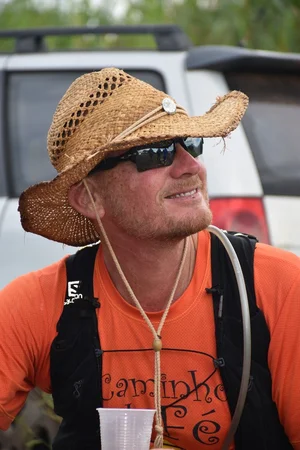
Jamey Masingill at the top of Broken Leg, Brazil 135, January 2015. He “muled” supplies up every foot of it and smiled the whole way!
I often measure my running pace in terms of it being "conversational," meaning I'm not gasping for air while running and can still enjoy a conversation with a friend.
Another gauge — because I often run alone — is that I can listen to an audiobook or a podcast and really concentrate on the narrative because my brain isn't busy negotiating terms with the effort required to keep up a fast pace.
Recently, however, I came across an episode of a podcast that really hit me hard.
The podcast is called "2000 Stories From the Dolphin Club," featuring short interviews with members of this historic cold-water swim club in the San Francisco Bay Area. The conversations offer fascinating insights into people of all ages, from diverse backgrounds and at different junctures in their lives, who all get something from jumping into the freezing-cold Bay.
I guess it's similar to how I feel adventuring out in the world on foot.
But one particular episode really stayed with me.
The interviewee was Theresa, a Dolphin Club member who is living with ALS, also known as Lou Gehrig's disease. As a result, she lost her voice, so the interview was conducted via a text-to-speech app. But her spirit could not be muffled. It came through loud and clear.
Theresa, a triathlete, a tax expert and a lawyer who is politically active, is also a mother and wife who considers herself lucky because she's beating the odds, alive and ambulatory past the disease's life expectancy. Yet she refused to be called "amazing" or "inspiring," and said she is simply carrying on "with life ... with joy as my guide; seems so much better than being sad or angry."
When she was diagnosed with bulbar-onset ALS — that's the one that attacks the voice and swallowing muscles — she recorded her voice so that the speech app would produce a semblance of her actual voice and not a purely robotic one. The developers also asked her to record a handful of phrases that she uses often, so that she could play them when needed and it would be her old voice that the person in front of her would hear.
What did she record?
"More Chardonnay!"
I listened as she spoke about getting into the Bay as often as possible, wearing a float and flippers, and relying on the help of her friends and fellow swimmers.
"Everyone circles me like friendly sharks," she said.
She discussed the effects of being in cold water and how the water showed her that it's okay to relax and be still.
"For decades, I worked high stress jobs, raised kids, trained for marathons and triathlons, political organizing, basically always in motion. Stillness equaled lazy in my mind," she said. "I have been forced to learn the value of stillness and accepting calm."
For someone who needs perpetual motion, this really hit home. Movement, something we take for granted and rarely appreciate, can be taken away so suddenly.
ALS has sadly intersected with my life a couple of times before.
When I was in high school, my Uncle Walter was the president of Burberry, the luxury British fashion brand, and he lived in a quintessential New York City loft in the late 1970s. He was also my idol, the one I wanted to grow up to be. Uncle Walter was a marathon runner and, on one memorable visit, took me on a six-mile loop through Central Park. Then, in his fifties, he was diagnosed with ALS. As his body deteriorated, he lost his high-powered job but refused to quit running marathons, which he continued to do in his wheelchair. After ten years of pushing himself to live, he succumbed to the disease.
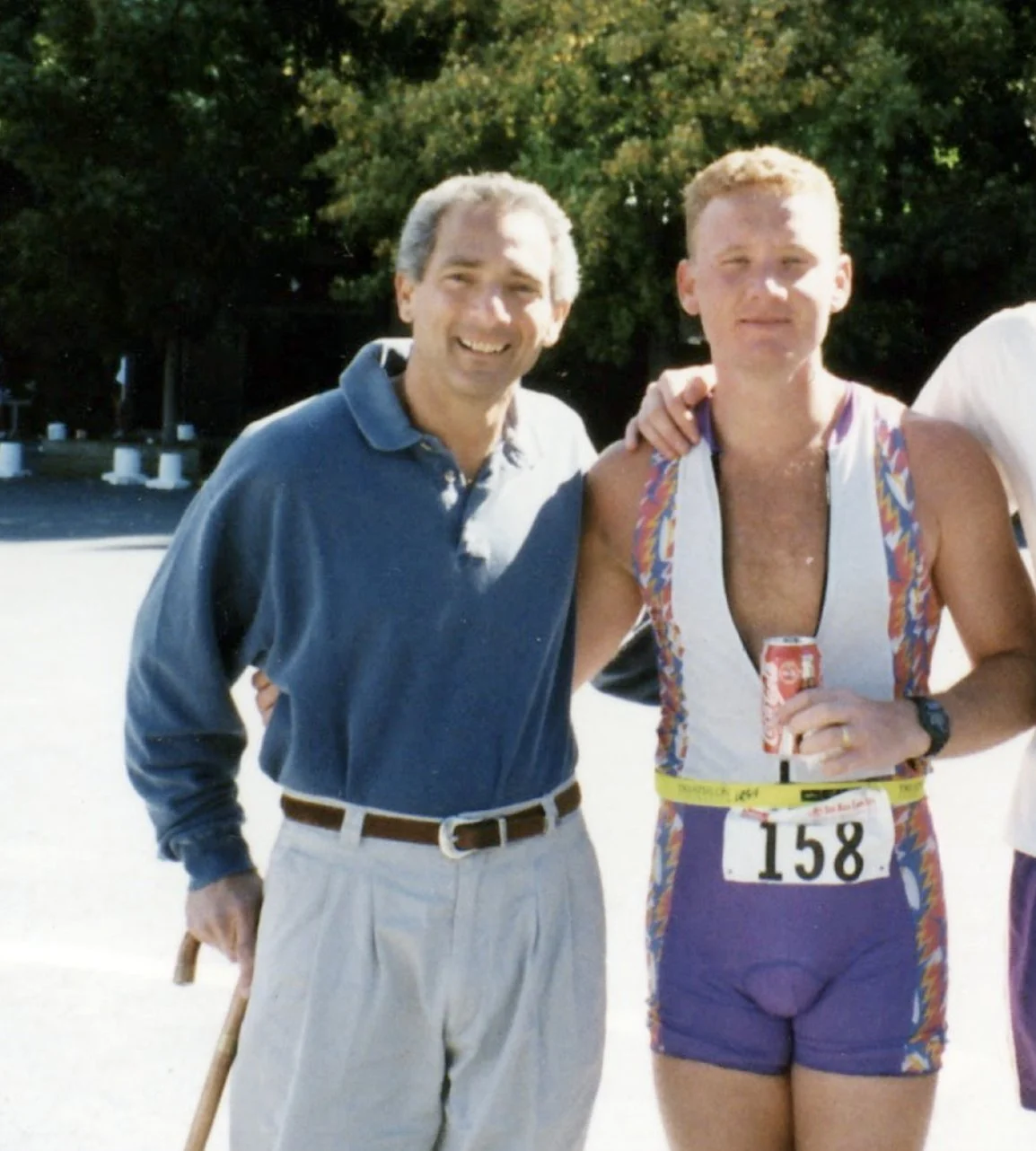
Uncle Walter and me at the finish of the Josh Billings triathlon, 1994.
Then there was my dear friend Jamey. In the fall of 2014, he told me over a beer one evening that he had been diagnosed with ALS. He was fifty.
"In my remaining time, I want to do as many meaningful things as possible," he said. "Got any recommendations?"
I sure did.
In January 2015, Jamey became my crew chief for my Brazil 135 ultra, despite having lost his motor skills on his left side. But he was all in, excited to support me on this epic race.
I remember the sight of him muling water and the supplies I needed up that steep, rocky 6,000-foot mountain, appropriately named "Broken Leg." I watched him dig so deep.
It had been an atrociously hot and humid day, but Jamey refused to complain or give up. In fact, he smiled all the way to the top, and once we summited, he may as well have climbed Everest, for that's how proud he was.
We crossed the finish line hand in hand, crying and smiling, proud in the knowledge that we had just accomplished something remarkable.
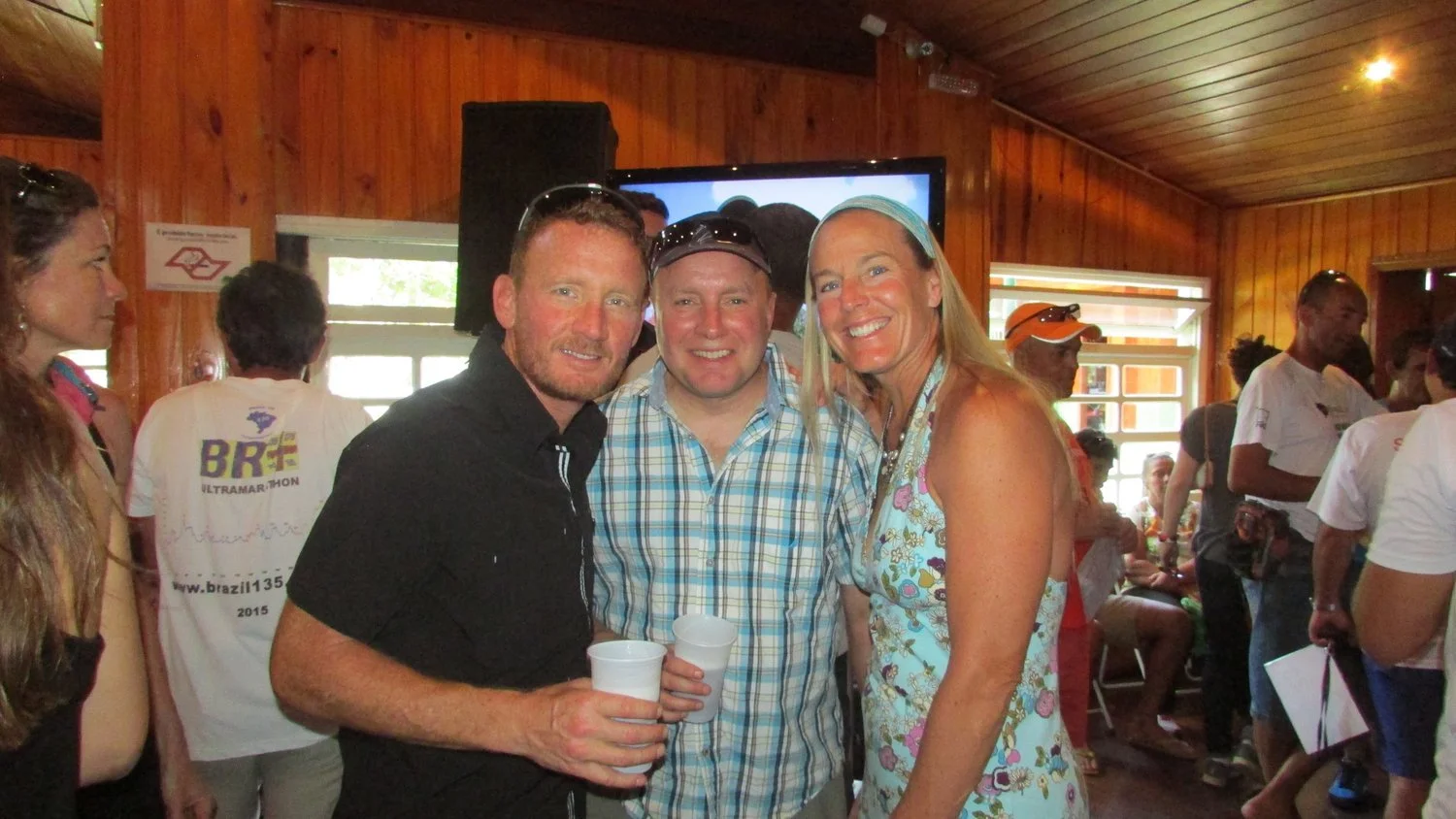
With Jamey and Lisa Smith-Batchen at the awards dinner after the Brazil 135, 2015. Left to right: me, Jamey, Lisa.
We lost Jamey a few months later when he drowned in the Caribbean while attempting to snorkel. Just trying to do meaningful things.
The images of Uncle Walter and Jamey smiling defiantly, and of Theresa ordering up more Chardonnay, are a reminder that running is a privilege.
And movement is a gift.
Hope to see you on the road.
Cheers,
David.
P.S. You can listen to Theresa’s interview here.