The Half-Full Way
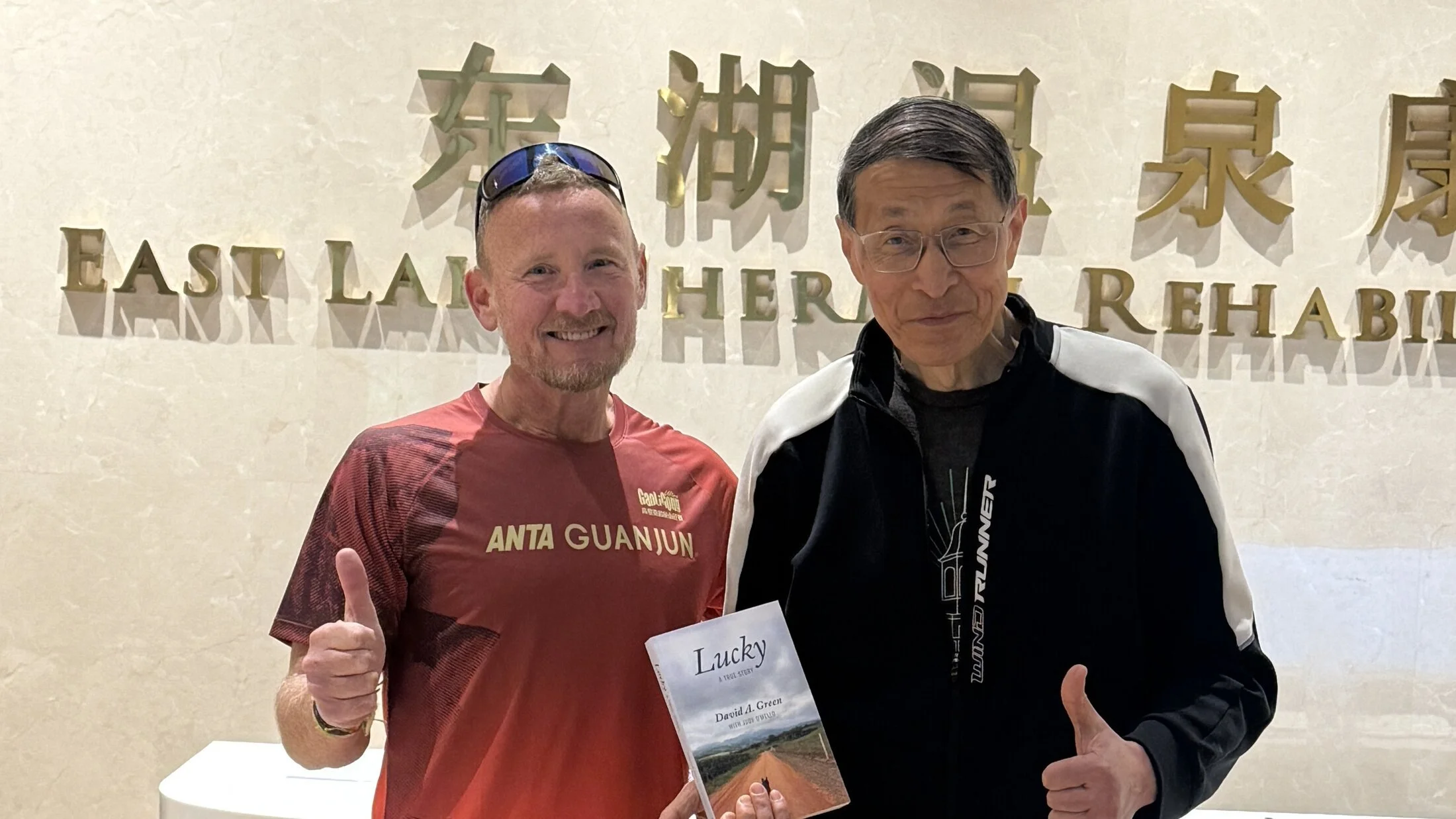
With Dr. Weimo Zhu after our interview at the East Lake Wellness Center in Tengchong, March 2026.
Issue #5
The Half-Full Way
"How do you train to run across a continent?" is something I hear often. People are curious and want to understand the investment required, the training plan, the mileage, the diet. The real answer is more subtle, and it took a scientist to make me say it out loud.
In March 2026, I visited China and sat down with Dr. Weimo Zhu, a Professor of Kinesiology at the University of Illinois and a Fellow of the American College of Sports Medicine. He has spent his career studying how people move, how movement can be measured, and how those measurements can improve health and performance. He founded the field of Kinesmetrics, creating one of the first doctoral programs devoted to applying measurement science to human movement. He has published more than 100 scientific papers, and in 2020 received SHAPE America’s Measurement & Evaluation Lifetime Achievement Award for his contributions to the field.
Dr. Zhu asked the other question I’ve also heard a thousand times. “What’s your secret?”
I told him the truth. I never finish a training session at one hundred percent, even a hard one. I always stop with something left in the tank, so the next morning my body, my mind, and my spirit are hungry instead of broken. No pain, no gain has never worked for me. Patience has. So, too, has showing up again and again.
He went quiet. Then he told me he had not heard it put that way before, and that it ran against most of what we are taught.
When you stop trying to max out, you slow down. When I crunch the numbers across all my big runs, that is exactly what they show. My net pace is about three miles an hour. Not because I am slow on my feet. I run a steady twelve-minute mile. It is because I stop for everything. Ten hours to cover thirty miles, and those ten hours hold every meal, every bathroom break, every moment worth standing still for, every conversation along the way.
The running is brisk. The day is unhurried. And it is the unhurried day, not the speed of my legs, that leaves me open to whatever is out there.
At three miles an hour I have ended up in kitchens I was never invited to. I have stopped to talk with a woman walking between cancer treatments, a couple finding their way through recovery, a teenager who still looked at the world like it was brand new. None of them were on my route. I ran into them because I was slow enough to be found.
That is the part nobody tells you. We treat slowness like failure, like something to apologize for. But speed costs you the encounter.
Don’t meet the world in a hurry – meet it at a pace slow enough to notice.
So this is the first step, the one I keep coming back to. You do not have to go faster. Find a pace you can sustain, and then stay open to whatever shows up while holding it.
Most training cultures worship the hard session, the one that leaves you wrecked. But wreckage compounds. The athletes I have watched burn out didn't lack drive. They lacked a ceiling.
Most training cultures worship the hard session, the one that leaves you wrecked. But wreckage compounds. The athletes I have watched burn out didn't lack drive. They lacked a ceiling.
Mine is somewhere between 60% to 80%. Here, my body is still tested but able to move for longer periods, while my mind is relaxed, being present and enjoying every moment. The discipline is harder than it sounds, because stopping before you're empty feels like quitting. It isn't. It's the method.
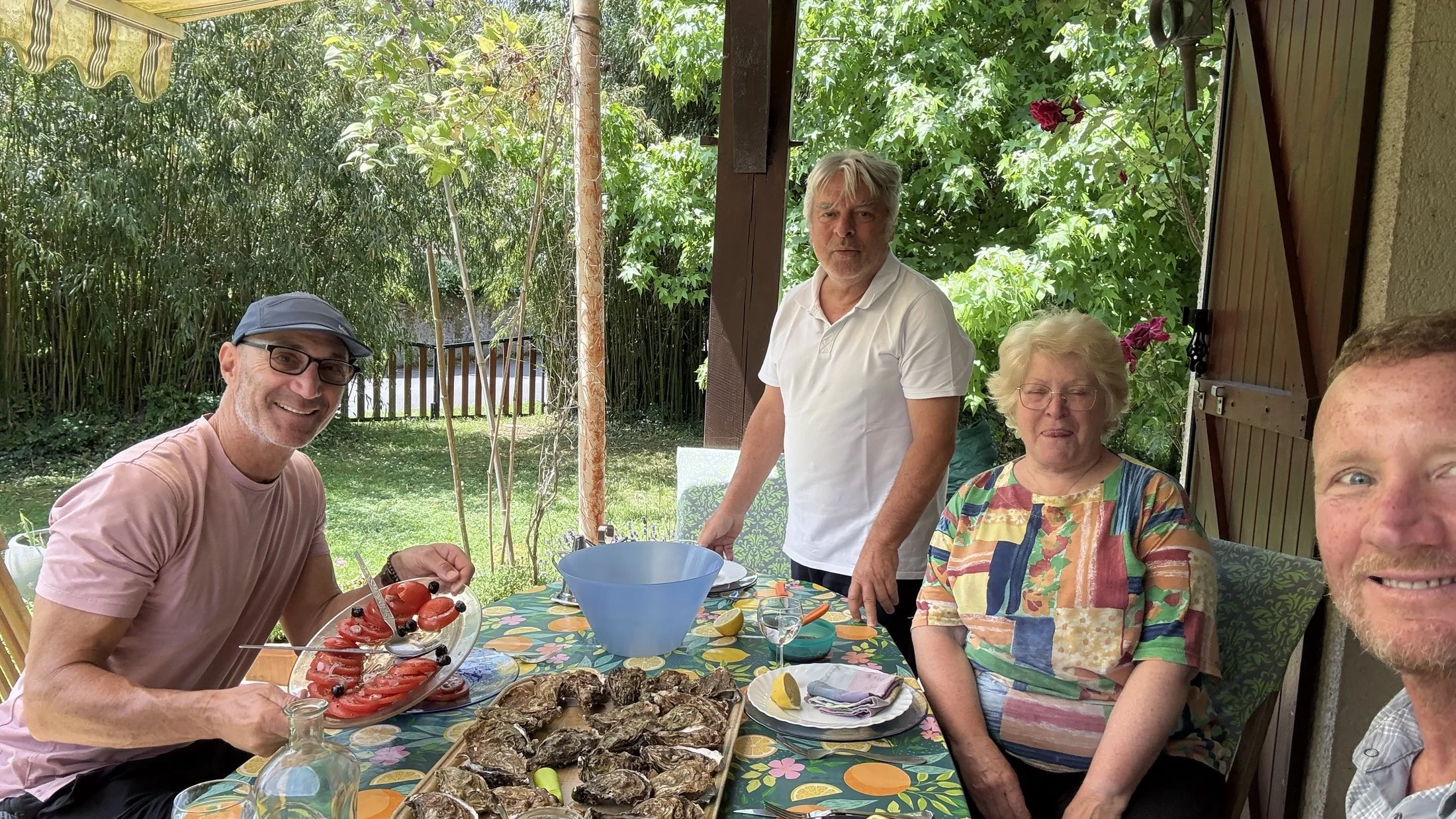
Oysters with strangers who became hosts in France. A table I was never invited to.
Go slow enough to run into something magical this week. I’d love to hear what that was for you!
Hope to see you on the road,
David.
P.S. On Tuesday morning, Bob Becker became the first 81-year-old to finish the Denali 135 Ultramarathon!