To Be Like Mike
Issue #11
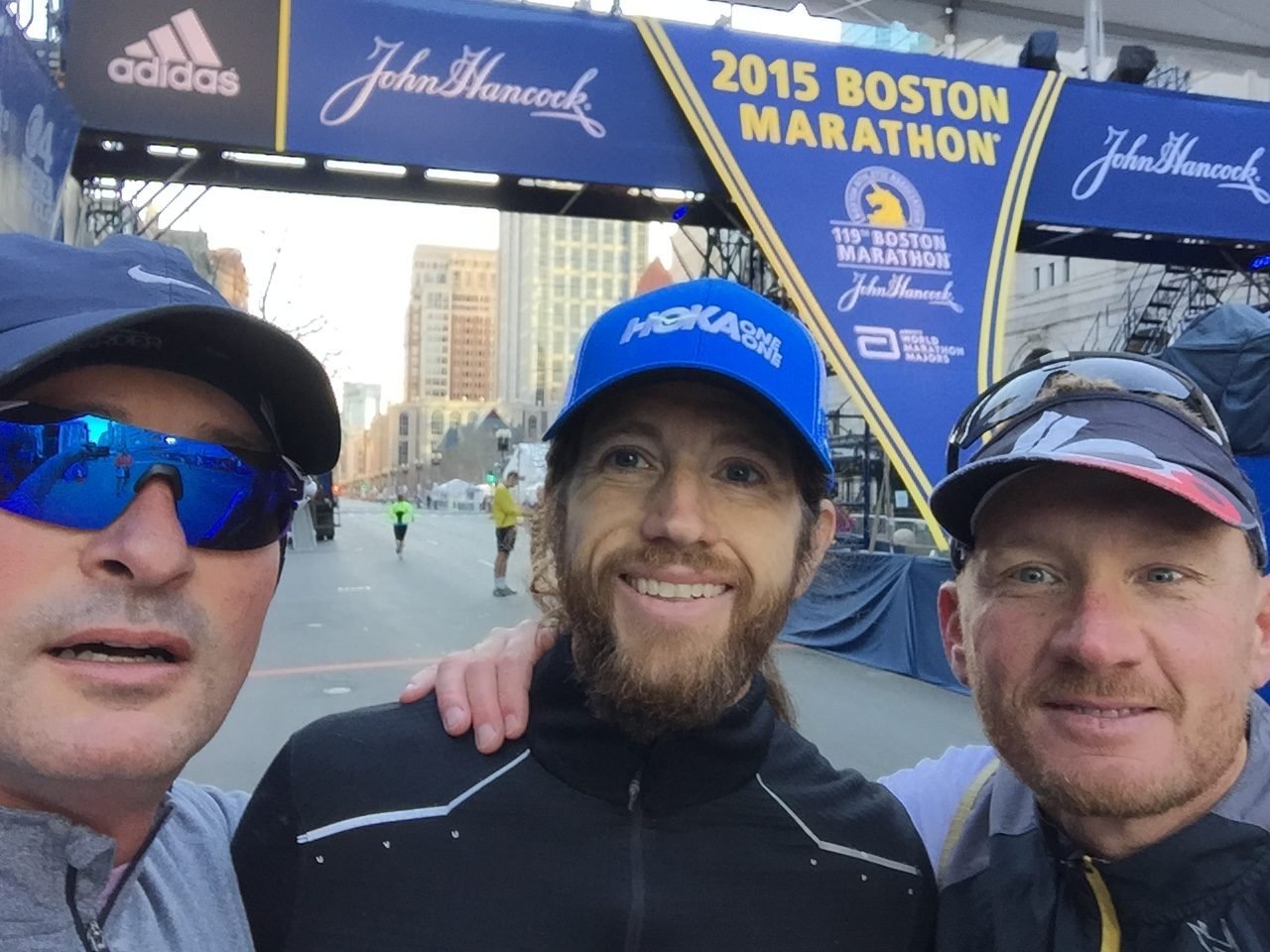
Barry Kahn, Michael Wardian, and me at the finish line of the 2015 Boston Marathon.
Great adventures start with curiosity. Those fairy tales we grew up hearing, the epic novels we’ve read, the explorations to the moon and the depths of the ocean — all usually began with someone needing to know more.
Curiosity plays a huge part in the world of endurance sports, too. My first transcontinental run — across America — began with a simple question: Can I run for 100 straight days?
But, I can’t talk about curiosity without mentioning Michael Wardian, the most relentlessly curious athlete I know.
Mike is the running, walking, rowing, climbing, never-standing-still embodiment of the principle of feeling comfortable being uncomfortable.
As one of the world’s most prolific ultrarunners, he has accomplished all that is humanly — and superhumanly — possible: multiple world championships for 50K and 100K; three US Olympic trials; Guinness world record in 2007 for running a marathon in 2:42:22 while pushing his son in a stroller; twice voted by USA Track and Field as ultramarathon runner of the year; former record holder of indoor and treadmill marathons; successfully completed all the major ultras and marathons; ran both Colorado’s Leadville 100 and the Pikes Peak Marathon in the span of 30 hours; set a world record for running seven marathons on seven continents in seven days; ran 3,000 miles across the United States in 62 days.
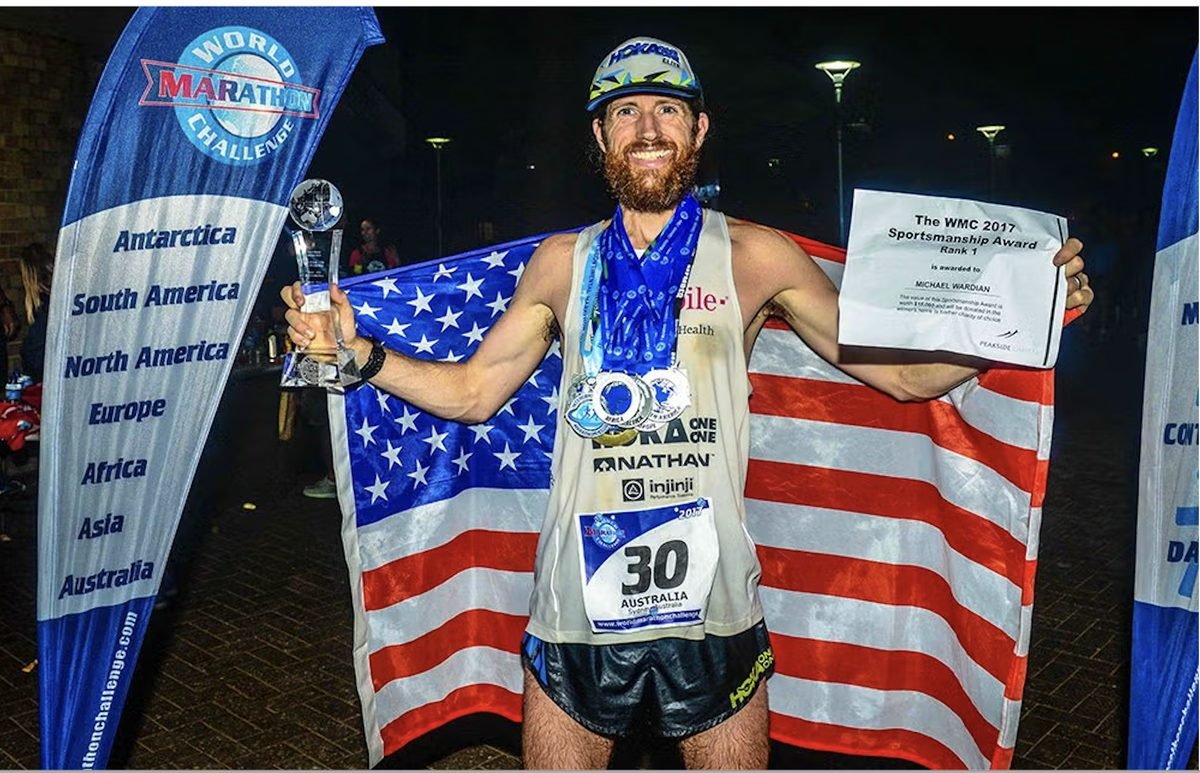
Michael Wardian after finishing the 2017 World Marathon Challenge in Sydney, Australia, holding the WMC Sportsmanship Award, Rank 1.
Remarkably, he’s not done. His next adventure is to row, solo, across the Atlantic in 2027.
Now, my curiosity was piqued.
Could I tackle such an adventure? Could I become a disciple of new experiences? Or, does it take a multi-talented dreamer like Mike?
Lucky for me, Mike is also a friend. So, I called him because I wanted to hear what fires up the brain of this renaissance man of endurance sport. It’s more than just his robust energy and daring that interests me — it’s his seeking system, the mental mechanism that pushes him to explore beyond his comfort zone.
“The row across the Atlantic is like an evolution in becoming more self-sufficient,” Mike told me on the call, casually adding that he’s looking forward to the challenge and solitude. “Once I leave the dock in the Canary Islands, I’ll be completely on my own for 40 to 50 days. That aspect really appeals to me.” He’s never been alone for such a stretch.
He needs to become a proficient rower, a whole new skill set for him. “I’m pretty nervous because I don't have a lot of experience on the water. So, that's a growth area for me. It's a chance to learn a lot of new skills,” he said.
What became obvious during our conversation is that Mike doesn’t focus solely on the result of his event but moreover on the process required for him to complete it. His goal is to row across the Atlantic, but his day-to-day focus is on the process of how to complete it successfully.
He’s building upper body strength, “to become row fit,” as he said. He trains six to seven days a week, anywhere from three to six hours a day, running, rowing, playing pickleball, CrossFit workouts, strength sessions, as well as doing a hundred burpees a day. Equally importan, he’s learning about ocean safety and how to use nautical navigation tools and desalination machines. And all the while, he runs an international shipping business.
The process-versus-goals model has been adopted by many highly successful people, in every sphere from dieting to business startups. Set a goal, then distill it into chunks of organized actions aimed at helping us successfully achieve our dream. It’s puzzle solving, which helps carve new and exciting neural pathways that offer dopamine hits, because the old pathways to walking, running, talking, etc., have become calcified over time.
And, when we succeed in our mission, the message to the brain is clear: We can be good at, well, anything.
“I think the biggest motivation is that I'm still curious to see what's possible,” Mike said. “When people burn out, I think they’ve lost that desire to see what they're capable of doing.”
This psychological side of sports and movement is thrilling. There's always something new to learn. As long as I stay bold and curious, and keep moving, there'll always be a puzzle for me to solve. And I love that.
Oh, out of curiosity, one last question for Mike: What’s after the Atlantic crossing?
“I want to be an international chess master,” he said, before adding, “I also promised my wife that I wouldn’t attempt to scale Everest before our youngest son turned 18.”
The boy hits that milestone in December.
Hope to see you on the road.
Cheers,
David.
PS: As you read this, Mike is running 2,650 miles across the Pacific Crest Trail, from Canada to Mexico. You can follow his 60-day journey on Instagram @mikewardian.